Mat Zaga

Hi, I'm Mat. After 10+ years at BCG and in technical product leadership — including Facebook and, most recently, spy satellites — I went back to maths grad school at Baruch, CUNY, in New York to get more hands-on and re-tool myself.
I graduate in December 2026 and am looking for an interesting full-time quant role · a role that could benefit from my maths skills and tech leadership background.
I don't expect you to spend your afternoon digging through my GitHub. Here are the architecture diagrams and write-ups behind my recent technical work, plus a few things a resume has no room for. Email me if you want to chat.
Recent technical projects
Before grad school
Skills and technologies
About me
 Baruch College, CUNY
MATHS DEPT MS · GPA 3.8+ · EXP. DEC 2026
Baruch College, CUNY
MATHS DEPT MS · GPA 3.8+ · EXP. DEC 2026
 LSE
MSc Applied Maths, with merit · 2013
LSE
MSc Applied Maths, with merit · 2013
 Erasmus University Rotterdam
Computer science minor · exchange
Erasmus University Rotterdam
Computer science minor · exchange
 Yandex School of Data Analysis
Masters programme · visiting student
Yandex School of Data Analysis
Masters programme · visiting student


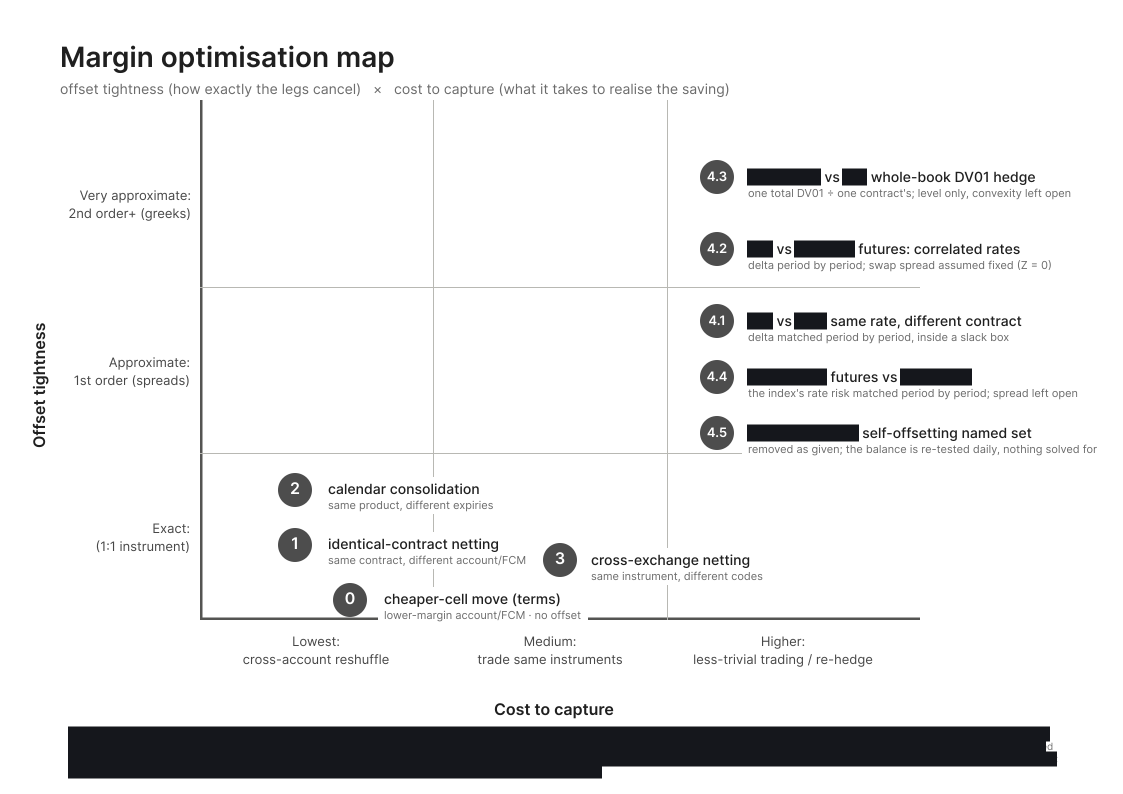
Prop desk margin optimisation
Built the desk's margin-optimisation pipeline end to end: exchange and broker positions in, equivalent-exposure lower-collateral trades out, ranked live on a trader dashboard.
CME and ICE APIs, SPAN and IRM margin methodologies replicated in-house; Python cron engine on headless Linux, Node/JS front end for the desk.
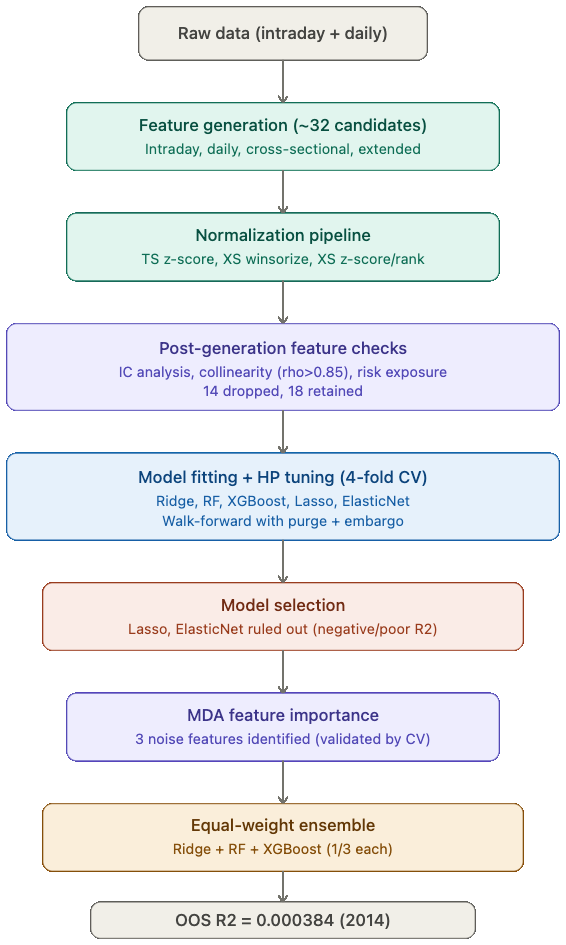
Forecasting 24-hour residual returns
Predicting 24-hour forward residual returns across ~875 US equities, 2010—2014, on 15-minute intraday snapshots and daily OHLCV.
Fairly standard clean pipeline: ~32 candidate features — intraday microstructure, aggregated intraday, daily price-volume, cross-sectional — narrowed to 18 by rank-IC screening, collinearity pruning and risk-exposure checks. Two-stage normalisation: per-stock 20-day rolling z-score, then per-date winsorisation and cross-sectional z-scoring. MDA feature importance was quite informative too.
RF alone performed a bit better OOS, but final submitted model for methodological purity was an ensemble of Ridge, RF and XGBoost; cross-validated weight search converged on simple equal thirds.
The only better result in the comparison group on the same data used 100's features which I didn't pursue to retain some parsimony.
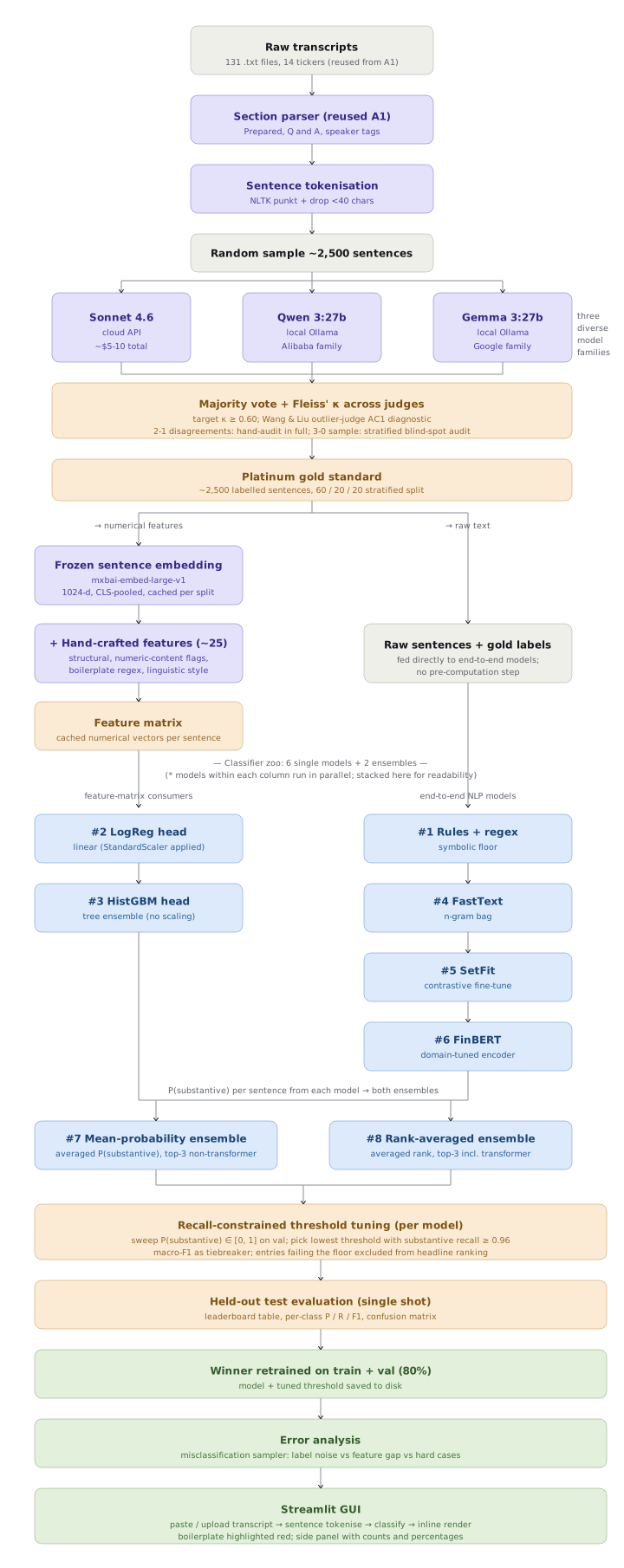
Calibrating a transformer that was sure of itself
Improved transformer calibration and robustness to overconfidence via label smoothing and temperature scaling for an earnings-call classifier — a SetFit / FinBERT / HistGBM ensemble, tuned under F1 and substantive-recall constraints.
The label set is the foundation: ~2,500 sentences from 131 transcripts judged independently by three model families (Sonnet, Qwen, Gemma), reconciled by majority vote with Fleiss' κ and an outlier-judge diagnostic; 2—1 disagreements hand-audited in full, unanimous calls sampled for blind spots.
Then a classifier zoo — rules, LogReg and HistGBM heads on cached embeddings plus ~25 hand-crafted features, FastText, SetFit, FinBERT, and two ensembles — with thresholds swept per model under a substantive-recall floor, macro-F1 as tiebreaker, and one single-shot held-out evaluation. The winner is retrained on train+val and served in a Streamlit GUI that highlights boilerplate inline.
A top-10 game bot on a tenth of the compute
generals.io is a two-player, real-time strategy game where you can't see most of the board. The competition version lets you build castles and gives you 150 ms per move on one CPU core. I started from a published self-play recipe and changed what the network sees, where its games start, how it was pushed to try castles, and how progress was measured.
Below: the training loop, then the improvements. Each letter is an improvement made at that step.
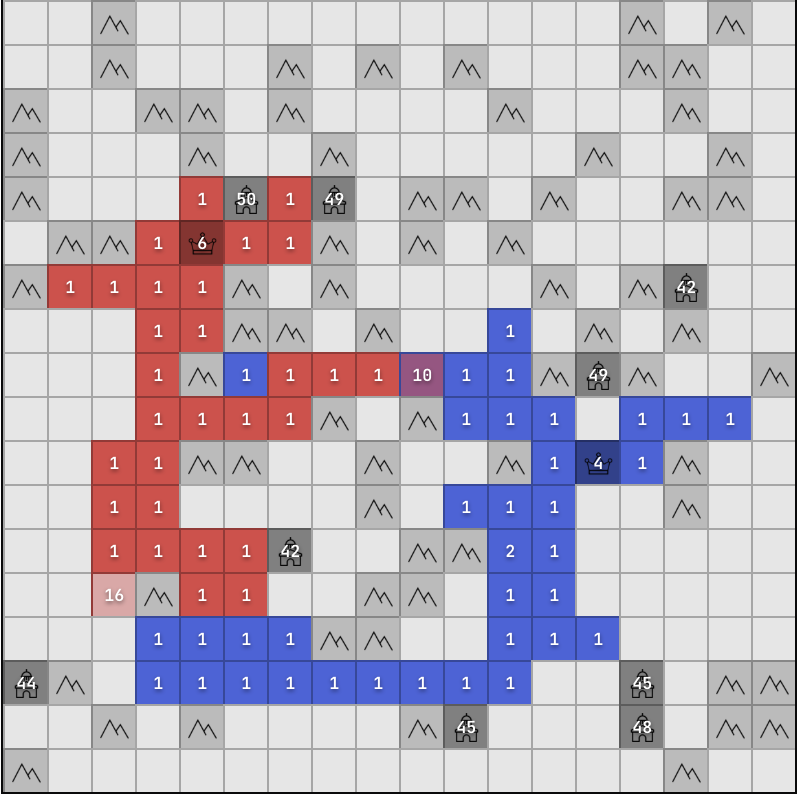
- 38 standard layers: armies, ownership, fog, move history.
- +11 derived: five threat maps — how soon an enemy force reaches each cell, how much could arrive, distance to your own general — computed in one fused pass.
- Countdowns to the turn-800 and turn-1200 rule changes; the raw turn counter can't resolve them in half-precision.
- Castle price per cell, computed by the game's own billing code, so it can never drift.
- A planned “predict the threat” output was cut and made an input: it's computable, so predicting it is leakage.
- Self-play rarely reaches rare decisive moments, so they're mined from 284k human games by exact rules: a castle built then lost within 50 turns; a 20-stack two squares from the enemy general but four by path; land taken behind you after first contact.
- Plus value surprises: moments where the network's own prediction flipped and never recovered.
- Restart 10 turns before the blunder so the network gets to choose differently; keep one tick per episode, not nine copies of one moment.
- A fresh agent never builds — 35+ army up front, slow payback — and a per-castle bonus makes it build everywhere.
- So the bonus is potential-based (Ng, Harada & Russell, 1999): after − before, cancels over a game, can't create a new optimum.
- Castle tries forced only on cells passing four rule checks: repays before turn 1200, leaves ≥1 army behind, no enemy force can reach it in time, nothing unseen within 3 squares.
- The forcing switches itself off on a cell once the network's own urge to build there passes 25%.
- Step size followed an inherited clock, 0.5 / t1.1, written for one 4,050-step run whose tail is the cooldown.
- Five legs resumed without resetting it: leg 3 stepped at 6.5e-5, leg 5 at 1.6e-5 — cooldown sizes, while still learning. Leg 5 read flat.
- The combination that hurt: tiny steps on a budget a tenth of the top bots'. The fix is two lines — reset the clock at each resume.
- Time-averaged weights ship inside hand-written rules — loop-breaker, mate-in-one check, doomed-castle veto — using 7 ms of the 150 ms budget.
- The other 140 ms measured unspendable: over 274,462 positions, the region a deeper proof needs to see was fully visible 0.89% of the time. Fog, not time, blocks depth.
- ~30,000 games on a laptop, each map played twice with sides swapped so luck cancels.
- Progress had been read against opponents already beaten 95%+ of the time — past that the scale goes blind (one “gate” at 108–0 carried ±3,277 rating points).
- Self-audit: +688 claimed across three legs, +320 real. Fix: score against live ladder ratings of opponents actually drawn; retire any yardstick once beaten past 85%.
- 15 frozen past versions, drawn in proportion to how often they still win; anything beaten >90% gets zero games.
- The draw weighting was found inverted for 1,700 steps — by logging which opponents were actually drawn, not by re-reading the code.
- 200k games on the new rules + 212k on the old. Instead of filtering to strong, current games (−80%), player skill and rule version were fed in as inputs — conditioning embeddings added to attention.
- Pre-registered test: the full messy corpus matched hand-curated data within 49 rating points on a 50-point tie line. Every position in all 8 board symmetries; split by map, not by game.
- Student shape per Straka & Schmid 2026 (deeper over wider at fixed budget). Distilling into a fresh net failed: 1.6% vs its teacher after 48k steps.
- Grew it Net2Net-style instead (Chen, Goodfellow & Shlens, 2016): copy every weight into a deeper net, insert four zero-output layers. Identical function on day one — 49% vs its teacher, untrained.
- ~$41 of GPU behind the shipped version — the chart's x-axis — and ~$185 across every training leg including the dead ends, against $1,000+ for the 3rd-place bot. Paid GPUs only trained; all 30k test games ran on a laptop, after testing had been eating 19% of every paid second on the rented box.
- Seven serving add-ons over ~20k paired games: one read +28, an independent 800 games put it at +4; the unchanged control varied 0.7275–0.7625 across map sets — nothing ships on one batch.
- Four attempts at a specialist to beat the champion (~$7), all collapsed within ~100 steps; each had been started from the champion's weights.
- Before believing “flat”: a snapshot against a bit-identical copy of itself scored exactly 0.5000.
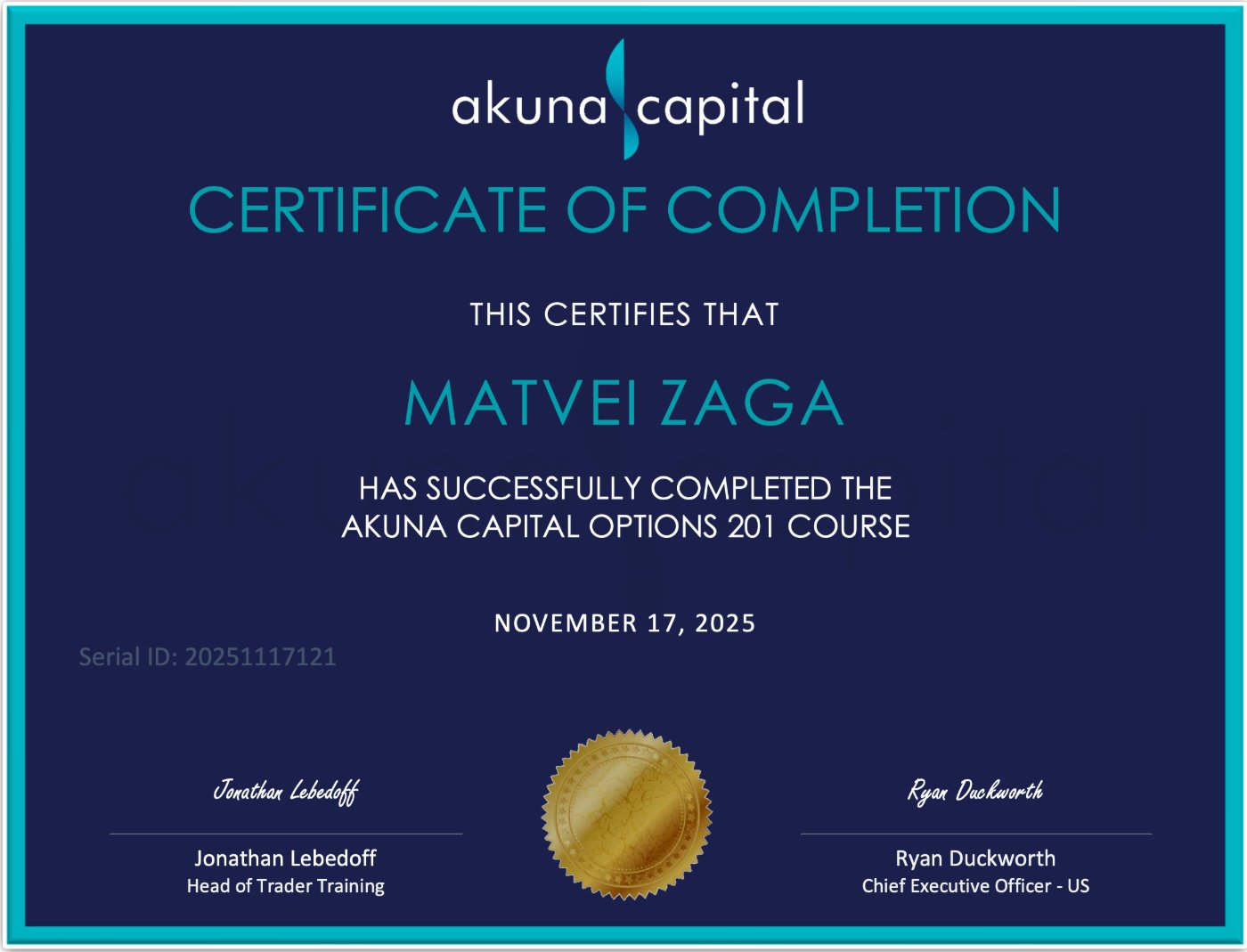
Options 201, examined
Trader-training course on options pricing and risk, completed with the closing examination.
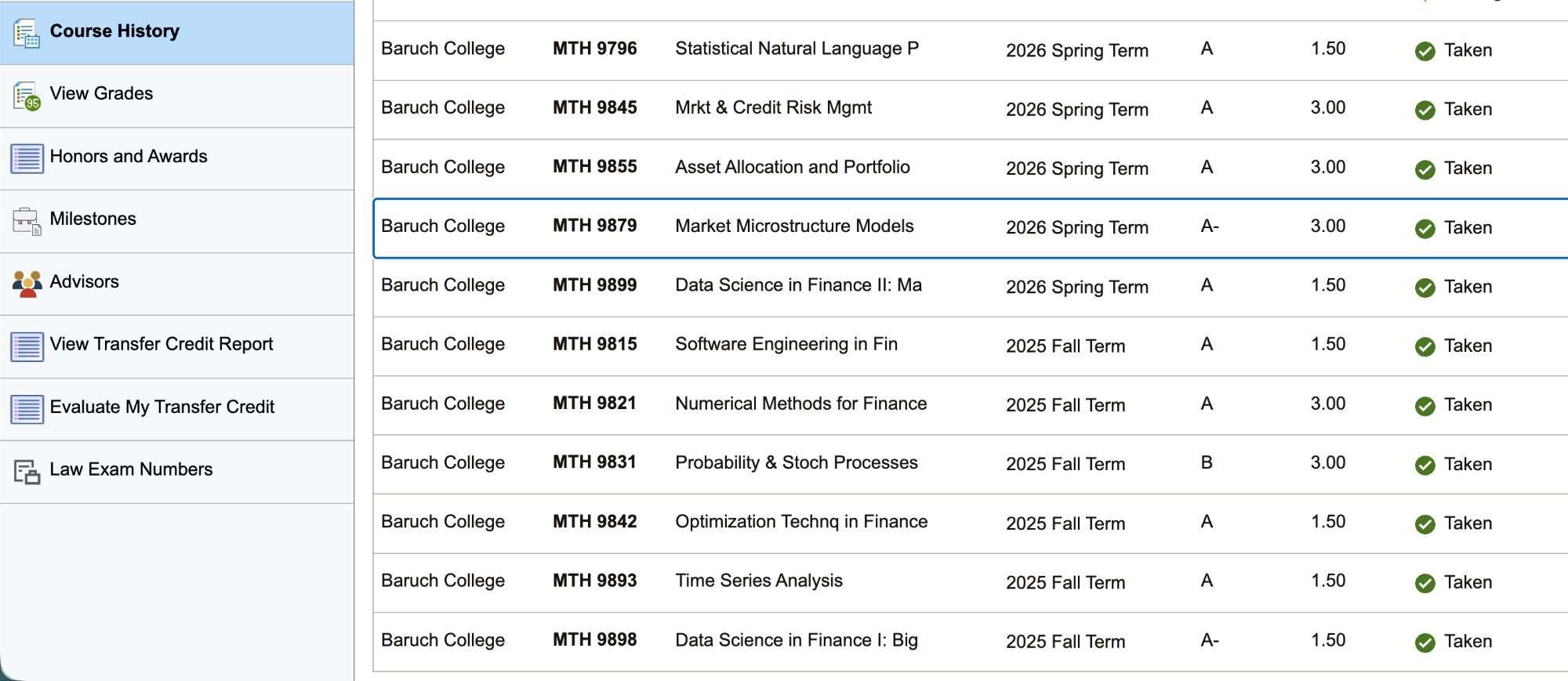
Preliminary transcript
Recovering imaging on a GPS-denied satellite
Details are confidential, but if you're curious about what to do, when a multimillion dollar satellite loses GPS in orbit - talk to me. Imaging depends on knowing quite exactly where the spacecraft is.
I led the recovery: entropy-based autofocus, external orbital data and curtailed view angles — restoring commercial-grade capacity on a >$20M asset that was facing write-off. Specifics are under NDA.
A contract role, taken deliberately as a bridge: it ran up to enrolling full-time in the Baruch graduate maths programme.
Real-time VR for enterprise - miles better than Meta Quest or Vision Pro
Took a real-time HD VR platform 0-to-customers against an Nvidia product with a thousand times the funding, leading 20 engineers.
 Watch on YouTube ↗
Data platform for a 2,000-person eng org
Owned the internal data-tooling platform: 10x data quality and org-wide adoption.
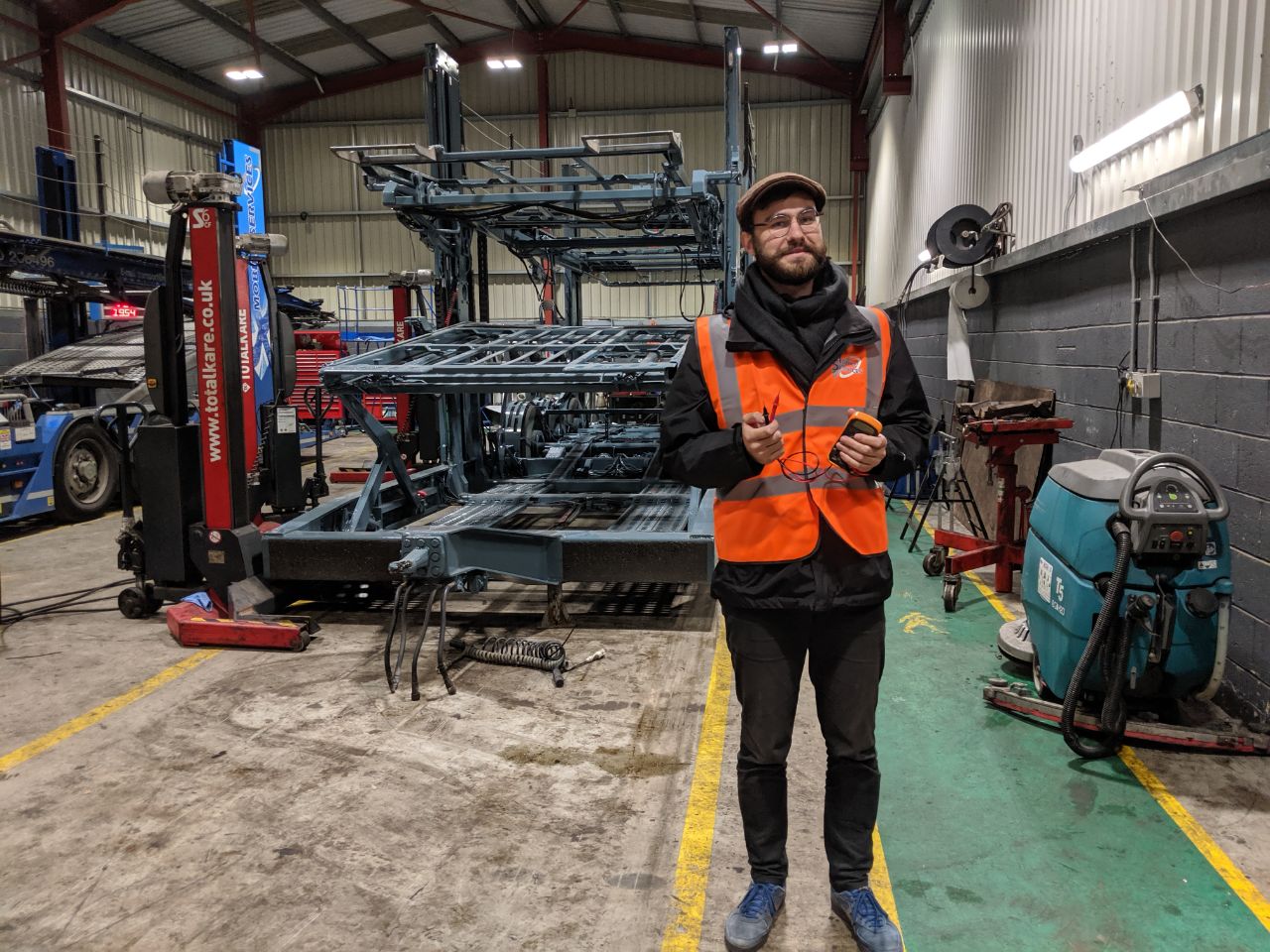
Patented fuel-efficiency scoring
Correlation and regression models over high-dimensional telematics — speed, RPM, pedal use, auxiliary equipment.
Most of the work was handling heterogeneous, partially missing signals and defining segmentation rules across vehicle classes so the score stayed interpretable.
Ad enforcement as a knapsack problem
Reframed a quality-versus-revenue enforcement decision under do-not-touch account constraints as constrained optimisation, backtested the policy on historical data, and shipped proof-of-concept code for production.

Telco churn from cell-level network quality
Modelled how cell-level network quality drove subscriber churn using geolocated data, and mapped the highest-churn cells into a maintenance priority list.